Oh boi, it’s been a year since I updated this site.
There are lot of things I need to share:
- I just graduated from UW with electrical engineering degree. My concentration was in Analog Circuit Design.
- I built so many cool things over the year, it helped me to think like a real engineer (thanks to Professor Darling and Professor Rudell)
- got a job working on 5G stuff
Anyways, 5G eh? Long story short, my capstone project that I did remotely due to Covid19, gave me a little insights about 5G. Our team built a homodyne (direct conversion) receiver for 2.5GHz 5G application. And 2.5GHz is actually band41 that T-Mobile got from their recent merger with Sprint (guess who’s working on it now ;))
High level explanation, the receiver itself consist of 3 main blocks:
- Low noise amplifier (LNA)
- Voltage-controlled oscillator (VCO) utilized MOS varactors
- I-Q mixers

I personally designed the VCO block. I used an LC tank to set the frequency, some buffer, and frequency divider using D-Flip Flops to produce a 90 degree phase shift that are needed by the I-Q mixers.
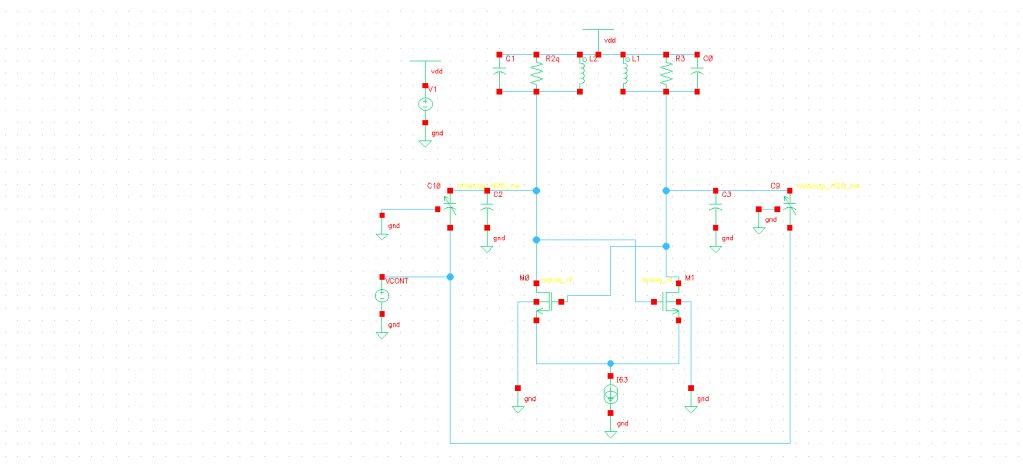


I built these on Cadence Virtuoso Circuit Design Environment, employed with a 65nm CMOS process. However, due to time constraints, we did not build the whole layout for this receiver, someday I will come back to this and finish it.

Complete Receiver Front-End Schematic
For the future post(s), I will share the detail on how to build this (the math behind it etc), instrumental amplifier (IA) applications, and I will talk about 5G.
Can’t wait to blog more.
Cheers,
Olce
 Olce's Brain Dumpster
Leave a comment